C. Marshall
May 28, 2026
There is nothing new under the sun.
Ecclesiastes told us that three thousand years ago, yet here we are in 2026, watching the same old story unfold willy-nilly across the evening news. The names and the technology have changed, but the game remains entirely the same: a powerful political machine that blends corruption with patronage, weaponizes government institutions against its enemies, rigs the vote when it can, and survives because it delivers just enough “help” to keep its dependents loyal.
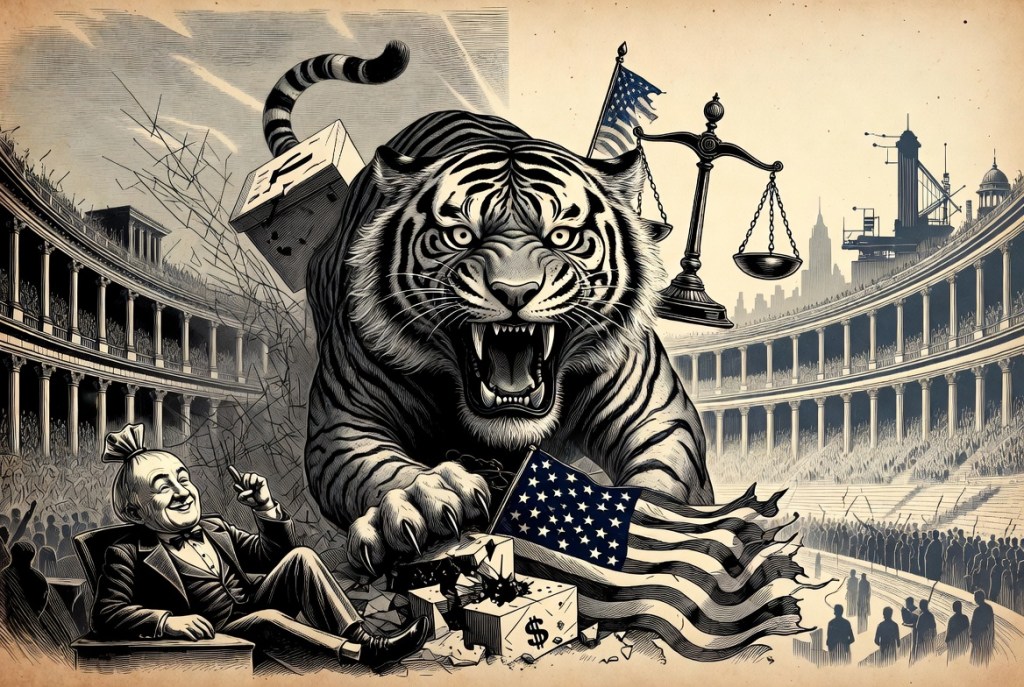
Call it Tammany Hall 2.0.
The original Tammany Hall began in 1789 as the Columbian Order—a patriotic, anti-aristocratic fraternal club that mocked European pomp with pseudo-Native American titles: Sachems, Wigwams, and the Delaware chief Tamamend. It was never meant to be a monster. But by 1800, Aaron Burr saw its raw potential. He turned that network of working-class men into a disciplined voting bloc for Thomas Jefferson, fusing the Tammany Society forever with the Democratic Party. What started as a social club became the most successful political machine in American history.
Fast-forward to our modern landscape. The contemporary political apparatus has undergone its own quiet pivot. What had once been a party of competing ideas has become, in the eyes of millions of Americans, something darker: a highly organized apparatus that fuses big government, tech platforms, legacy media, and federal agencies into a single, self-protecting engine of power.
The parallels are not poetic exaggeration. They are piquant, precise, and unmistakable.
Dishonest Graft, Modern Edition
Boss Tweed and his infamous ring plundered New York with a $13 million courthouse that should have cost a mere fraction of that price. Carpenters, plasterers, and contractors kicked back fortunes while the city bled. The machine’s operational philosophy was simple: control the apparatus, control the outcome. Estimates of the Tweed Ring’s total theft run between $50 million and $200 million—hundreds of millions in today’s dollars.
In recent years, we have watched a twenty-first-century version of this exact same dishonest graft. Weaponized narratives, highly questionable dossiers, and targeted investigations have been built on opposition research, funded by political campaigns, and laundered directly through the federal intelligence community. When official oversight reports finally laid these schemes bare, the machine simply shrugged and moved on to the next indictment, the next raid, the next lawfare campaign.
Political persecution became policy. Opponents were no longer debated—they were prosecuted.
Consider the absolute suppression of critical news stories just days before a major national election, where dozens of former intelligence officials falsely labeled verified reporting as foreign disinformation. Major social media networks throttled the narrative at the direct request of political campaigns and federal officials. That was not journalism; that was election interference dressed up in a suit and tie.
Tammany’s old-school “repeaters” and stuffed ballot boxes have been replaced by mass private funding of public election offices, last-minute administrative rule changes, and systemic censorship. The methods evolved. The raw mélanger of power and self-preservation did not.
Honest Graft, 21st-Century Style
George Washington Plunkitt famously bragged about what he called “honest graft.” If the city planned to build a park, he bought up the swampland first and sold it back to the public at a massive premium. “I seen my opportunities and I took ’em,” he said with a winsome grin.
Today’s insiders play the exact same game on a national scale. The only difference is that the swamp is regulatory, the land is green-energy subsidies and federal contracts, and the premiums are measured in billions of taxpayer dollars.
Family members and close associates of powerful political brokers secure lucrative board seats, consulting fees, and investment windfalls that smell exactly like the old Tammany playbook. The modern machine has simply perfected the art of never leaving messy fingerprints on the courthouse ledger. It proudly calls its graft “public-private partnerships.”
The Paradox of Patronage
Here is where the machine becomes truly vexatious—and why it endures. Tammany survived because it actually helped the desperate. When Irish and Italian immigrants stepped off the boats, the ward boss was right there with food, jobs, bail, and a straight party ticket in return. The padded bills and stuffed ballot boxes were somebody else’s problem; the loaf of bread on the table was an immediate reality.
The modern version is subtler but no less effective. Waves of identity politics, sweeping student-loan forgiveness promises, heavily expanded welfare programs, and targeted federal spending function as the new, institutionalized patronage system. The expected return? Absolute loyalty at the polls.
Question the machine too loudly, and you risk being labeled an existential threat to democracy itself. The poor and the dependent are still being served just enough to keep the votes flowing, while the real power brokers feast in the secure back rooms. It is patronage dressed up in the language of compassion—creating a dependent class that confuses the ward boss with a savior.
The Reformer’s Reckoning—And the Christian Hope
Tammany finally cracked under the pressure of independent judicial commissions (the Seabury Commission), aggressive merit-based civil service reforms under Fiorello La Guardia, and Franklin Roosevelt’s New Deal, which bypassed local political bosses to deliver aid directly from Washington. The old order died not with a bang, but with a quiet whimper in 1967.
We are living through a similar historic inflection point. The exposure of weaponized lawfare, the release of internal tech-company files, congressional oversight hearings, and the growing public fatigue with endless, transparently timed prosecutions have begun to do what Thomas Nast’s biting cartoons once did: shine a merciless, unblinking light on the machine.
Whether current reformers succeed where past ones faltered remains to be seen. But one thing is certain—the machine never goes quietly. It lays low, waits for the reformer to stumble, and reemerges under a new, more polished Sachem.
As a Christian who has stared down stage IV colon cancer and five brutal years of treatment, I have learned something incredibly simple about history and about grace. Empires and political machines rise and fall. They always have. What endures is not the Wigwam or the White House, but the God who raises up reformers and judges nations. Tammany’s ghost walks the halls of power today not because evil is ultimate, but because we have forgotten that our true citizenship is in heaven.
The ballot box still matters. Prayer still matters more. And the call to repentance—to tear down every high place of corruption and return to the ancient paths—remains the only lasting remedy.
History is repeating itself, brothers and sisters. But so is the mercy of a God who is never caught off guard.
Let us watch, pray, and vote with eyes wide open—neither milquetoast in our convictions nor polemic in our despair. The machine is old. The Gospel that can redeem even a Boss Tweed is older still.
And that, my friends, is our raison d’être.
References & Further Reading
- Riordan, William L. Plunkitt of Tammany Hall (1905). (The classic firsthand account of political machine dynamics and the concept of “honest graft.”)
- The Tweed Ring Records. Historical documentation of the New York County Courthouse scandal. (Itemized budgeting of $250,000 versus the final expenditure of ~$13 million, with total estimated fraud between $50–$200 million.)
- The Durham Report (May 2023). Report of the Special Counsel on the origins and conduct of the Crossfire Hurricane investigation by the Department of Justice.
- The Twitter Files (2022–2023). Internal corporate communications and investigative reporting regarding social platform content moderation and election-period information management.
- The Seabury Commission & La Guardia Reforms. Historical analyses of the structural decline of New York machine politics via municipal civil service reforms and the federalization of local aid under the New Deal.


Leave a comment