C. Marshall
May 28, 2026
I am a pipe smoker. I say that with quiet pride—no apologies, no defensive qualifiers. It is not a vice or a crutch. It is, quite simply, a return to being.
As a boy, I would sit at my father Richard’s feet and watch him tend his pipe collection the way other men polish tools or shine shoes. Each bowl carried its own story. He packed the tobacco with the slow, deliberate care of a man who understood that some things cannot be rushed. The first draw released unforgettable fragrances: sweet cherry and warm vanilla, spicy leather and deep, loamy earth. Instantly, the whole room would soften. Those scents are stitched into my memory the way certain hymns are stitched into the soul. They meant safety. They meant presence. They meant the rare luxury of a father who has always been here for me.
Some good Christians look sideways at a pipe these days and whisper “sin.” Yet, I have read the Book many times over the course of my life, and I have yet to find a single verse condemning tobacco. Jesus turned water into wine at Cana. Paul told us not to get drunk with it, but he never called moderate enjoyment evil. Our bodies are temples, yes—but the temple was built for worship, not for frantic, joyless purity tests. True pipe smokers do not inhale the way cigarette users do; we taste. We sip the smoke the way a connoisseur sips a fine bourbon. For me, after five brutal years of cancer treatments, that gentle nicotine has been a documented anti-inflammatory mercy. It settles the collywobbles no pill could touch, acting as a quiet, unexpected friend that modern medicine cannot replicate.
But health is only part of the story. The deeper magic is older than any doctor’s chart.
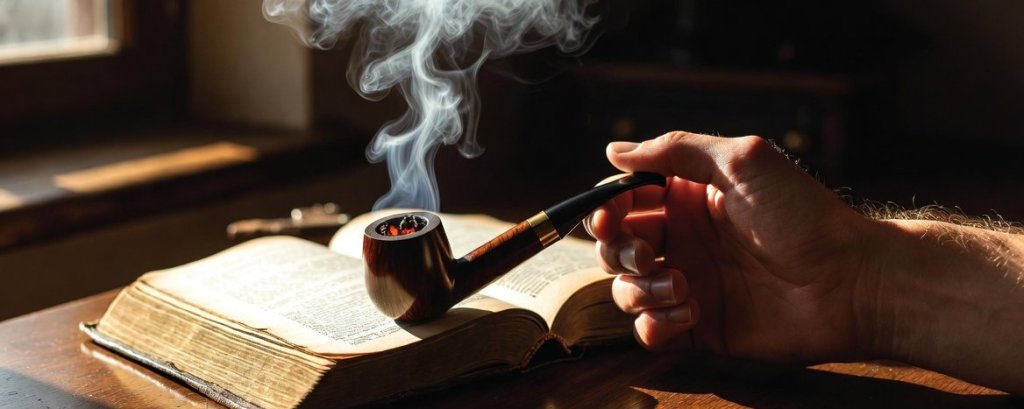
In the relentless desert of doing—the emails, the notifications, the endless race to prove our worth—the pipe is a small, fragrant rebellion. You choose an old briar. Perhaps a Peterson, or a simple corncob like the ones that kept Popeye and Captain Ahab company in my boyhood imagination. You pack it with care: Deluxe Navy for nautical memory, a cherry blend that tastes like childhood, or a rich Cavendish whose very name means comfort. You strike the match, draw gently, and let the rhythm of your own breathing slow until the world outside the bowl fades. At the right moment of stillness, you can even blow a perfect smoke ring. You don’t force it; you simply become so quiet that the air itself cooperates. One “O” of the lips, a soft pop, and there it floats—expanding, drifting, a private cathedral of smoke.
I am active for one brief minute so that I may become gloriously passive the next. In that mellow, blue-gray space, something beautiful is born that never would have arrived if I had stayed clenched in productivity. The day’s weariness dissolves. The iPhone stops its insistent trill. The false race, the pushing of the stone uphill, the thousand little tyrants of modern life—all of it gets packed into the bowl and exhaled as fragrant rings that rise like prayers.
This is the same quiet companionship I feel with the great American pipe men who shaped our cultural imagination. General Douglas MacArthur clenched his corncob while staring down history on the deck of a battleship. Mark Twain spun whole universes between puffs while the Mississippi rolled by. Bing Crosby crooned with one tucked in his pocket, and Norman Rockwell painted everyday American fathers doing exactly what my own father did—sitting still, thinking deep, letting smoke carry the soul somewhere higher. Anchoring them all was my father Richard, whose quiet sessions taught me that strength is sometimes measured in the stillness between draws.
The pipe also keeps company with the literary saints. Tolkien and Lewis, Tennyson and Twain—all of them knew the smoky muse. When I sit down to read or write, the bowl glows like the burning bush that stopped Moses cold. It says, “Take off your shoes. The ground here is holy. Stop doing and simply be.” In that sacred pause, I meet the muses. Poetry arrives. Clarity arrives. Gratitude arrives.
Some evenings the ritual is solitary. Other evenings it becomes the golden fellowship C.S. Lewis once described—friends gathered, slippers on, pipes lit, the world shut out while something larger opens up. Either way, the pipe is a bridge across time. I sit in the company of every man who ever packed a bowl and let the day go. I feel the living lineage of ordinary saints who understood that grace is not earned by grinding at the mill, but received in the quiet rhythm of smoke and breath.
So I light my pipe with thanksgiving. It is a small burnt offering, rising fragrant and free. The pressures and the hype and the noise are packed away in tobacco leaves and blown away in rings. What remains is the primal gift God gave us from the beginning: the simple, astonishing permission to be. And in that mellow, smoky space, I am free at last—free to do nothing, and therefore free to do the only thing that finally matters: receive everything, again, by sheer grace.


Leave a Reply